

Published:
Apr 25, 2016
Updated:
Oct 10, 2026

An extended example applying ASC 606's three criteria for recognizing revenue over time to goods and measuring revenue over time using inputs or outputs.

In Step 5 of the ASC 606 revenue model, companies recognize revenue when (or as) performance obligations are satisfied. An entity must assess whether revenue should be recognized over time or at a point in time. This can include assessing whether the customer controls an asset as it is created or enhanced. For revenue recognized over time, an entity must choose either an input method or an output method to measure progress. These three topics are each covered separately in the following articles: Revenue Recognition Over Time, Determining the Transfer of Control, and Accounting Input vs. Output Methods in ASC 606. This article provides a comprehensive example to illustrate the recognition of revenue over time for a product or asset.
E-Vehicle is a manufacturer of Electric Vehicles for fleet customers. The company offers two models of a delivery van, one with a 50-mile range (the E-van) and another with a 200-mile range (the LE-van). They recently entered a contract with RxRunner (a medical courier company) to provide 50 E-vans and 50 LE-vans.
RxRunner provides courier services for medicine, medical documentation, and small medical equipment. All 100 vans will be customized with a vehicle wrap advertising RxRunner. In addition, the LE-vans will be outfitted with a refrigerated medicine compartment to keep medicine at a proper temperature during longer deliveries. This refrigeration compartment will create a larger load on the vehicle's battery, which will necessitate the installation of larger batteries. E-Vehicle has not sold any vans to medical courier companies previously and is unaware of any similar potential customers. The larger batteries and refrigeration equipment will significantly reduce the interior storage capacity of the van.
The contract provides E-Vehicle with a unilateral right to terminate the contract to protect itself in case of supply chain failures by its vendors, and E-Vehicle is only entitled to payment for vehicles already delivered should it exercise this right. Alternatively, if RxRunner cancels the contract, then E-Vehicle is entitled to payment for all vans already delivered, as well as compensation to cover the costs and a reasonable profit for any partially completed LE-vans. In the past, E-Vehicle has not elected to enforce a similar right to payment when a customer cancels a contract. Additionally, the agreed-upon billing schedule only provides payment with the delivery of every 10th E-van and every 10th LE-van.
The manufacturing process involves E-Vehicle purchasing a van chassis and body (all components aside from the drivetrain) for each E-Van and LE-Van. These components are purchased from a large US automaker (US Motors) for $20,000 per vehicle. Then E-Vehicle installs its own proprietary drivetrain. The primary components of this drivetrain are an electric motor and a battery pack. To prevent overheating, the vehicle requires the installation of a vented cooling system for the battery. Additionally, regenerative brakes are installed to conserve energy that would otherwise be lost during braking. As a final step, any contract-specific modifications are made to the vehicles. Until this point, the vehicles are interchangeable and could easily be directed to any customer. Each vehicle (E-vans and LE-vans) is considered a separate performance obligation.
E-Vehicle has assessed steps 1-4 of the revenue model and has identified the following performance obligations along with their allocated portion of the transaction price and their expected cost.

E-Vehicle needs to determine if it should recognize revenue over time or at a point in time. If recognizing revenue over time is appropriate, it must decide whether using an input method or an output method to measure progress is appropriate.
If a performance obligation meets any of the three criteria for revenue recognition over time, then it must recognize revenue over time. Otherwise, revenue will be recognized at a point in time. E-Vehicle considers the three criteria in Accounting Standards Codification (ASC) 606-10-25-27 to determine whether it should recognize revenue over time:
The Financial Accounting Standards Board (FASB) clarified that criterion A is generally not intended to apply to contracts where an entity’s progress results in an asset but rather is intended for service-type contracts (BC 125, 128). Because the benefits of E-Vehicle’s performance are not simultaneously received and consumed, and this contract results in the creation of an asset, this criterion is not satisfied.
From the background information provided, there is no indication that E-Vehicle is creating or enhancing an asset that the customer controls while manufacturing the vans. Consequently, Criterion B is not met. In a different circumstance, this criterion could be met provided the indicators of the transfer of control in ASC 606-10-25-30 demonstrate that the customer controls the asset.
Criterion C is useful in some situations where the first two criteria are difficult to apply. This criterion may be used for either goods or services that are specific to a customer. To meet this criterion, the asset created must (1) not have a feasible alternative use, and (2) the entity must be entitled to payment. These elements of this criterion are addressed separately below.
No contractual restrictions prevent E-Vehicle from redirecting the vans produced under this contract to another customer. However, the analysis should also consider practical limitations. A practical limitation exists when redirecting the asset would result in significant economic losses (ASC 606-10-55-10). This assessment should be made at contract inception and based on the condition of the goods at completion. The fact that the vans remain interchangeable prior to final modifications is not a relevant factor in this evaluation.
All the vehicles will be customized with a vehicle wrap advertisement, but this could be removed without E-Vehicle incurring significant economic losses. As this is the only customization for the 50 E-vans, these vans have an alternative use, and revenue should be recognized when they are delivered to RxRunner (i.e., at a point in time). Because these vans have an alternative use, it is not necessary to determine if E-Vehicle is entitled to payment.
For the 50 highly customized LE-vans, E-Vehicle must assess whether the completed units could be sold to another customer without significant rework or economic loss. The entity first evaluates whether there is an alternative market for the vans in their completed form and concludes that no such market exists. Due to the inclusion of larger batteries and specialized refrigeration equipment, the vans are uniquely designed for medical courier use. As a result, E-Vehicle determines that it could not redirect the vans without either undertaking substantial rework to remove these features or accepting a significant loss on sale. Accordingly, the entity concludes that its performance does not create an asset with an alternative use.
E-Vehicle’s payment schedule lags behind its performance of the contract, but this is not evidence against an enforceable right to payment for performance to date (ASC 606-10-55-11 through 15). E-Vehicle determines that if RxRunner cancels the contract, its will be able to recover its costs as well as a reasonable return on capital. Although E-Vehicle has previously made a business decision not to enforce its right to payment in similar contracts, with the help of its legal counsel, its determined, based on legislation and legal precedent, that it does, in fact, retain an enforceable right to payment. Consequently, E-Vehicle determines that revenue should be recognized over time for the 50 LE-vans.
Assume a similar contract and situation as provided in the facts above, with the following changes. The contract does not contain provisions to ensure that E-Vehicle is entitled to payment for performance completed to date. RxRunner can cancel the contract at any time for any reason. RxRunner pays in advance but is entitled to a proportional refund at its discretion. E-Vehicle facilitates a transaction between RxRunner and US Motors for RxRunner’s purchase of 100 van chassis and bodies for $20,000 each.
Subsequently, E-Vehicle contracts to install its proprietary drivetrain into these shells. RxRunner purchases insurance to protect its assets. The vans are specifically identified by VIN and can be picked up at any point in the installation process, with payment for completion to date. Although RxRunner maintains title to the vans during the installation of the drivetrain, E-Vehicle maintains a mechanics lien whereby it is legally entitled to payment for performance through a security interest in the title. The modifications to the vans are the same, and the contract price and expected cost are similar (but reduced by $20,000 per van).

If E-Vehicle’s performance creates or enhances an asset that RxRunner controls, then Criterion B is met. Therefore, the key question is whether RxRunner can direct the use of, and obtain the benefits from, the vans. This also includes the ability to prevent other entities from directing the use of the asset. To assist in making this determination, ASC 606-10-25-30 provides a non-comprehensive list of indicators of the transfer of control:
Although E-Vehicle does not have an explicit contractual right to payment, legal precedent in its jurisdiction provides a mechanics lien that establishes a security interest in the vans, effectively enabling the entity to secure payment. RxRunner holds legal title and bears the significant risks and rewards of ownership, as evidenced by its procurement of insurance. While no customer acceptance clause is identified in this scenario, entities should consider this indicator when applicable. E-Vehicle’s continued physical possession of the vans does not preclude a transfer of control, consistent with bill-and-hold arrangements. After evaluating the relevant indicators of control, E-Vehicle concludes that RxRunner controls all 100 vans. Accordingly, Criterion B is satisfied, and revenue should be recognized over time.
After determining that revenue is recognized over time, E-Vehicle must determine whether to use an input method or an output method to measure progress and record revenue. The selected method should depict the entity’s progress in satisfying the performance obligation. Output methods often provide a more direct measure of value transferred to the customer; however, they may not accurately reflect performance when significant work-in-process or finished goods are controlled by the customer but omitted from the selected output measure. Additionally, depending on the situation, output may be difficult or costly to observe. Input measures should also be considered, as they may be more observable and provide a better measure of the entity’s progress. Ultimately, whichever approach depicts the entity’s completion most faithfully should be used.
Assume the initial case facts. E-Vehicle has determined that it will recognize revenue at a point in time (when each van is delivered) for the 50 E-vans and will recognize revenue over time for the 50 LE-vans.

E-Vehicle takes a job-shop approach to manufacturing vehicles, with several mechanics working on a single vehicle. The process takes approximately 2 hours for a team of mechanics, and vehicles are completed one at a time. Because of an efficient scheduling and manufacturing process, work-in-process inventory at the end of any day is negligible.
In this situation, an output method is most appropriate, as this will reflect E-Vehicle’s economic performance. Because there is negligible work-in-process inventory, E-Vehicle determines that it will recognize revenue with the completion of each custom LE-Van. To determine the portion of the transaction price that it should recognize, E-Vehicle divides the $3,750,000 transaction price by the 50 vans and recognizes $75,000 of revenue with the completion of each vehicle.
Assume now that E-Vehicle uses an assembly line approach to manufacturing its vehicles. This approach includes dozens of production steps. There are several general phases of production, and within each phase, there are several sub-phases. Consequently, at any point, several vehicles will be at various sub-phases of production. The following table details the hours and costs required for each step, the percentage of total hours and costs, and the proportion of the transaction price that E-Vehicle is entitled to for a vehicle in a given stage of completion. (Percentages are rounded.)
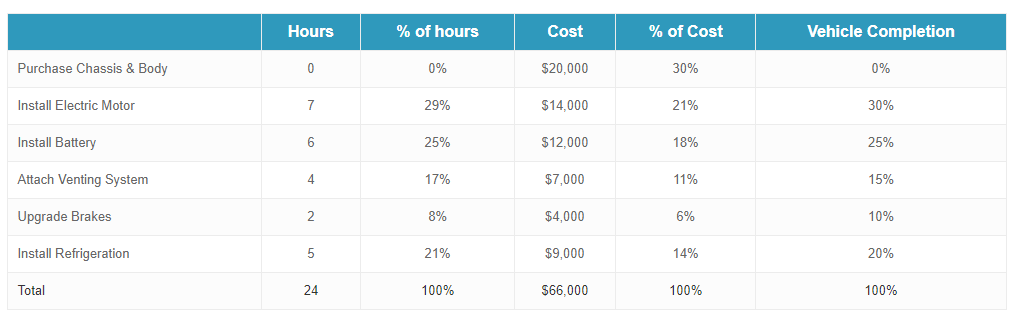
Under this manufacturing method, E-Vehicles has significant work-in-process, and at any given point, vehicles can be at one of a few sub-phases. Consequently, E-Vehicle’s process is not directly measurable, and evaluating the progress based on an output measure would likely be difficult and costly. Consequently, E-Vehicle decides that it should use an input method. E-Vehicle notes that the number of hours closely reflects the vehicle completion, and the costs incurred do not. Therefore, it decides to recognize revenue based on the number of hours spent. To the extent that an unexpected amount of labor is wasted (for example, a strike or bottleneck causes an increase in labor hours), revenue should not be recognized for that input (606-10-55-21A).
Similarly, if E-Vehicle determines that a cost-based input method should be used, then it must exclude costs for the purchase of the vehicle chassis and body, as this cost does not contribute to the entity’s progress. Consequently, the percentage of completion should be recalculated as follows.
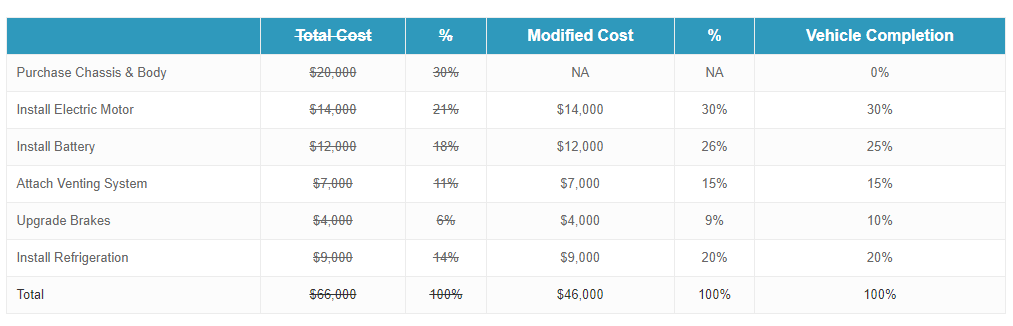
By ignoring the costs that do not reflect the satisfaction of a performance obligation, the costs now more appropriately reflect vehicle completion.
Two of the three criteria in ASC 606-10-25-27 are used to determine whether revenue should be recognized over time to produce assets. Criterion B depends on whether the customer controls an asset as it is created or enhanced, while Criterion C depends on both the right to payment and on whether an asset has an alternative use. Upon determining that revenue will be recognized over time, an entity must determine which method of measuring progress to use. Either an output or an input method can be used, depending on which method most faithfully represents the satisfaction of performance obligations.
This article was reviewed in 2026 for consistency and correctness in accordance with present guidance. This article reflects guidance under ASC 606, Revenue from Contracts with Customers, as currently codified, including subsequent amendments. The concepts discussed remain relevant as ASC 606 has not undergone substantive changes regarding the recognition of revenue over time.