


Published:
May 16, 2020
Updated:
Oct 10, 2026

Under ASC 606, rights of return are generally treated as variable consideration, though the accounting may differ depending on the type of contract.

Many entities allow customers to return goods for any reason within a specified timeframe. Returns can be made in exchange for a full or partial refund, store credit, another product, or some combination of the above. Sales with a right of return create accounting issues because the amount of consideration to which the entity will ultimately be entitled is uncertain.
Many entities also offer customers a trial period or the option to accept or reject delivered goods based on either subjective preferences or clearly defined objective criteria. These return provisions are referred to as customer acceptance rights. Although customer acceptance rights appear similar to a right of return, these two notions are treated differently in ASC 606. Rights of return affect the estimate of the transaction price (step three) to be allocated among performance obligations, while customer acceptance rights affect the determination of when control transfers (step five). See The Five-Step Method for more information.
ASC 606 requires that rights of return be treated as variable consideration. Upon transfer of control, an entity that has entered into a contract with a right of return should recognize:
Revenue is recognized only for the portion of the sale that the entity expects to retain. The portion expected to be returned is recorded as a refund liability. An asset should also be recognized for the entity’s right to recover goods expected to be returned, measured at the former carrying amount of the inventory less any expected recovery costs and reductions in value. Inventory costs that exceed this expected return value of the inventory should be expensed as cost of goods sold.
With this method, revenue recognized at the point of the original sale does not include amounts to which the entity does not expect to be entitled, and the refund asset is not overvalued. When the return period expires, any remaining refund liability is recognized as revenue, and the related refund asset is either reclassified to inventory or recognized in cost of goods sold.
Entities must follow all of the guidance for variable consideration when accounting for rights of return, including applying the constraint. This does not necessarily require a two-step process of estimating returns and then separately applying the constraint. As explained by the FASB in ASU 2014-09, a separate evaluation of the constraint is unnecessary if the entity’s estimate of expected returns already reflects the level at which it is probable that a significant revenue reversal will not occur. See Variable Consideration and the Constraint for more information.
While some may consider it reasonable to present refund liabilities and refund assets on a net basis, the standard indicates that these items should be presented separately. ASC 606-10-55-27 explains that the asset recognized for the right to recover products must be measured independently and presented separately from the related refund liability.
Although the standard does not explicitly address whether return assets must be presented separately from inventory, interpretive guidance from accounting firms consistently supports separate presentation on a gross basis (EY, Section 5.4; KPMG, Section 5.4.20). This view reflects the fact that the refund liability and return asset represent fundamentally different economic elements—one is an obligation to the customer, while the other is a right to recover goods. Netting these amounts would obscure both the entity’s exposure to refund obligations and the value of expected recoveries.
In addition, presenting the return asset separately from inventory enhances transparency and comparability, as the return asset is subject to unique measurement considerations (e.g., expected recovery costs and potential value reductions) and separate impairment evaluation. As a result, gross presentation—separating the refund liability, return asset, and inventory—is generally viewed as more decision-useful and consistent with the principles of ASC 606.
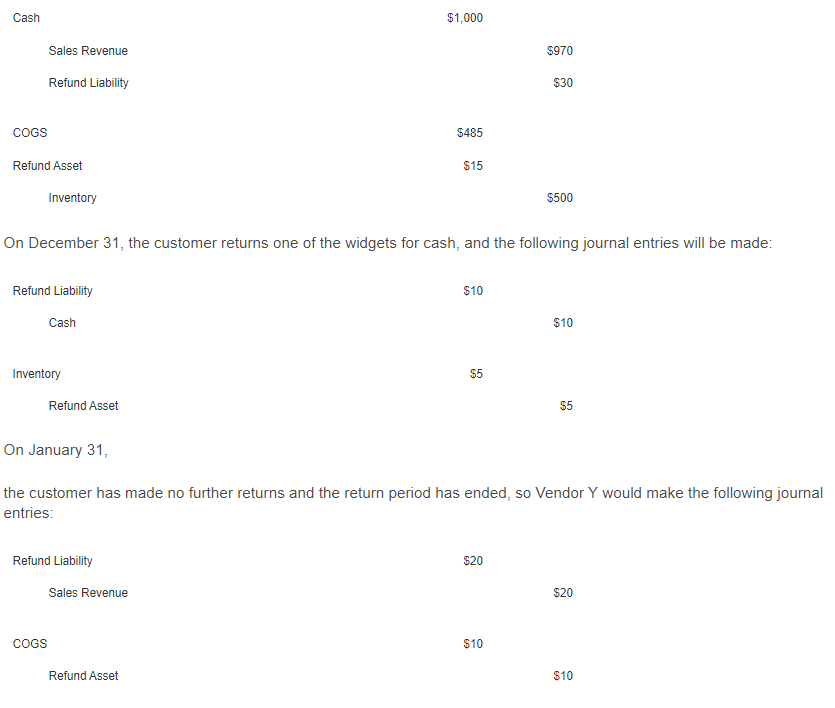
Vendor Y enters into a contract on December 1 with a customer to provide 100 widgets for a total consideration of $1,000. The terms of the contract, which are consistent with Vendor Y’s practices, allow for returns for any reason for up to 60 days for a full refund in either cash or store credit. Vendor Y has significant historical experience with customers of this type and expects an average of 3 percent of all widgets to be returned.
Analysis:
On the date of the sale, Vendor Y determines that it expects to be entitled to the full $970 for the 97 widgets not expected to be returned. Vendor Y determines that it is probable that no significant revenue reversal will occur for this amount. On this date, Vendor Y would make the following entries (assuming the carrying cost per widget is $5):
Customer acceptance is one of the criteria for determining transfer of control in the revenue recognition process. If this criterion is not met, revenue recognition should be deferred. Determining whether customer acceptance exists requires careful analysis of the acceptance provisions or clauses within the contract.
Customer acceptance rights may be based on objective criteria, such as size, weight, or specific performance metrics. If an entity can demonstrate that a delivered product meets the objective specifications in the contract, then control has effectively passed to the customer, and the entity should recognize revenue. In some instances, determining that objective customer acceptance rights have been met is a formality because the entity has sufficient experience with similar products being accepted according to the objective criteria in the contract. However, even without such history, an entity may still be able to objectively determine that control of a good or service has been transferred to the customer in accordance with the specifications in the contract (see ASC 606-10-55-86).
Conversely, if customer acceptance rights are based on non-objective criteria, then the entity is prevented from concluding that the customer has obtained control of the good or service. For contracts without objective criteria, entities typically defer revenue recognition until the customer formally accepts the product or service. In some cases, entities may allow a trial period for customers to determine whether they want to keep the product. If the customer is not obligated to pay consideration until the trial period expires, control does not transfer until the trial period lapses or the customer accepts the product.
In addition to the guidance discussed above, recent updates clarify the accounting for share-based consideration payable to customers. ASU 2025-04 further explains how equity instruments granted to customers affect the transaction price and are accounted for under Topic 718. While this update does not change the accounting for rights of return or customer acceptance, it clarifies related guidance affecting consideration payable to customers. See Noncash Consideration for more information.
Under ASC 606, rights of return are treated as variable consideration, so revenue should only be recognized for those goods not expected to be returned. A refund liability, presented separately from the associated refund asset, should be recognized for those goods expected to be returned. At the end of each reporting period, the refund liability should be updated to the amount for which it expects to be entitled in exchange for the goods. Corresponding changes should be made to the transaction price and the amount of revenue recognized in the transaction.
If all other revenue recognition criteria have been met for a contract with customer acceptance rights, an entity should recognize revenue when the customer signals acceptance of the goods or services, the acceptance period lapses, or the entity can objectively determine that the contract specifications have been met. Only in these circumstances can the entity conclude that control has been transferred to the customer.
The guidance discussed above continues to apply under current U.S. GAAP as of 2026, as no significant amendments affecting rights of return or customer acceptance have been issued since the adoption of ASC 606.