

Published:
Feb 28, 2015
Updated:
Oct 10, 2026

Analysis and examples of when to treat multiple distinct goods or services as one performance obligation (a series) under ASC 606

Under Step 2 of the Revenue Recognition model, Accounting Standards Codification (ASC) 606 introduces the “series” provision, which intends to simplify accounting for contractual arrangements in which a series of distinct goods and services that are substantially the same are treated as a single performance obligation. Without this provision in the guidance, each good or service would be accounted for as its own performance obligation with a separately allocated transaction price.
The series provision falls under Step 2 of the Revenue model: identify the performance obligations in a contract. According to ASC 606-10-25-14, a performance obligation is a promise to provide either:
(a) a distinct good, service, or bundle of either; or
(b) a series of distinct goods or services that (1) are substantially the same and (2) are transferred with the same pattern to the customer.
To qualify for series treatment, both requirements (1) and (2) must be met.
A series of distinct goods or services that are substantially the same are those that are separately identifiable (i.e., distinct) within the context of an arrangement, such as one delivery out of a set of 10 monthly deliveries, or each identifiable increment in a long-term service contract. (For more information on distinct goods or services, see Distinct Goods or Services in ASC 606.)
The guidance does not provide a clear definition to use for determining whether goods or services are “substantially the same.” Instead, the guidance contained in ASC 606-10-55 provides three illustrative examples:
In all three cases, the services are substantially the same and would be treated as a single performance obligation. In each example, services are delivered consecutively. It is worth noting, however, that the standard does not state that consecutive delivery is necessary for distinct goods or services to be a series.
ASC 606-10-25-15 provides two criteria for determining whether a series has the same pattern of transfer:
The series provision is intended to simplify the application of the revenue model and promote consistency in identifying performance obligations when an entity provides essentially the same service over time.
On January 1, 20X1, Seasnack IT Company enters into a 3-year contract with Aluster Telecom to provide a monthly system service for $36,000. At the time of contract inception, Seasnack’s standalone selling price for a year of service is $12,000. The services provided are the same each month, and the pattern of transfer to the customer is the passage of time (services provided per month).
As such, Seasnack determines that it is providing a series of distinct services (1) that are substantially the same and (2) have the same pattern of transfer. Therefore, the services will be treated as a single performance obligation satisfied over time.
In situations where an entity enters into a contract with the customer to provide non-distinct services, the services may be accounted for as a single performance obligation. If that arrangement contains variable consideration (such as a performance bonus or discount), the entire variable amount is allocated to that performance obligation.
However, in a transaction covered by the series guidance, variable consideration is allocated to the distinct good or service to which the consideration relates. For example, suppose that the contract between Aluster and Seasnack provides an all-or-nothing 10 percent annual bonus ($1200) to Seasnack if the service is completed within the first two weeks of all twelve months of the year. In Year 1, Seasnack completes service within the first two weeks of every month. Because the bonus relates specifically to the distinct services provided during Year 1, Seasnack allocates the bonus to those services and recognizes it at the end of Year 1.
The accounting treatment of contract modifications depends on whether undelivered goods or services are distinct from those already transferred. If they are distinct, including circumstances when the remaining distinct goods or services are a part of a series, the contract modification is accounted for on a prospective basis. If they are not distinct, the contract modification is accounted for as a cumulative adjustment. (See Contract Modifications Part I and II for more information on accounting for contract modifications.)
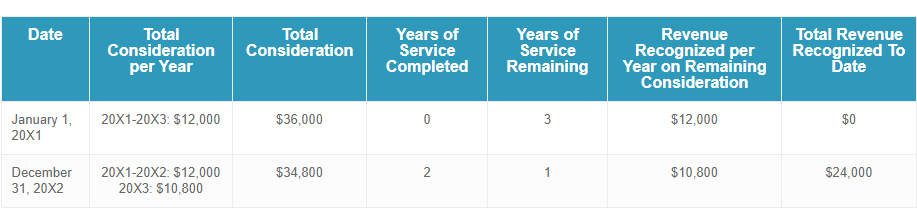
Recall the example of Seasnack’s contract with Aluster. Suppose that on December 31, 20X2, the two parties negotiate a price reduction so that the services for Year 3 will be priced at its present standalone selling price of $10,800 for the final year. Because the single services performance obligation is a series of distinct services in accordance with ASC 606-10-25-14(b), Seasnack will allocate the change in transaction price entirely to the distinct services after the modification (in other words, there will not be a cumulative adjustment to revenue for the prior years as a result of the price reduction).
 Part B: Extension of Contract Length
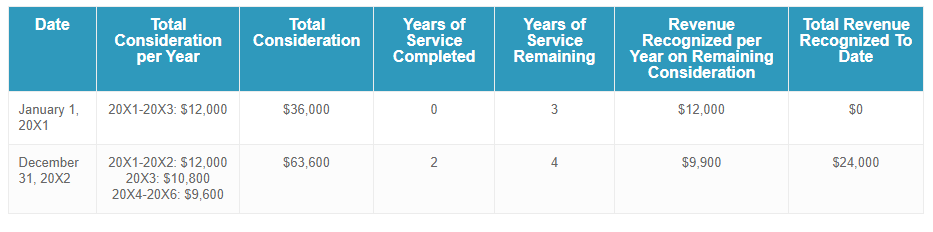
Suppose the modification also extends the life of the contract for an additional three years (from January 1, 20X4 – December 31, 20X6) for an additional $28,800 ($9,600 per year). Seasnack will recognize the remaining amount on a straight-line basis, or $9,900 per year.
Some stakeholders assume that the distinct goods or services must be performed consecutively to be recognized as a series. Proponents of this view cited the following guidance from Accounting Standards Update (ASU) 2014-09 to support this position:
Additionally, previous drafts of the standard contained the word “consecutively” when addressing accounting for series guidance. The word was also included in papers prepared by the FASB’s staff during the re-deliberations process for the 2011 Exposure Draft. Proponents assumed that the word’s inclusion in the previous draft underscores that the FASB’s intention when drafting the guidance was for the series guidance to apply only to goods or services delivered consecutively.
Although Transition Resource Group (TRG) discussions are non-authoritative, they provide insight into the FASB’s intent and have been widely referenced in practice. BC113 does not explicitly exclude goods or services that are not delivered consecutively; rather, it states that the intention is to promote a more constant approach in those circumstances when delivery is consecutive.
Furthermore, BC116 is a response to comments on the 2011 Exposure Draft that questioned whether the proposed guidance at the time applied only to consecutively delivered goods or services. The FASB responded, stating that it had intended to address consecutively delivered goods or services rather than address those goods or services concurrently delivered. The FASB indicated that it did not believe explicit guidance on accounting for concurrently delivered goods or services with the same pattern of transfer is necessary. However, the FASB has never stated that the guidance would not apply to those that are concurrently delivered. The FASB ultimately removed the word “consecutively” from the final draft, and TRG members generally agreed that a series of distinct goods or services need not be consecutively transferred.
Finally, the only guidance on determining if concurrently delivered goods or services qualify as a series is the statement that the goods or services must be delivered using the “same pattern of transfer.” Concurrent transfers can certainly fit that description.
When accounting for a series as a single performance obligation, entities may find that the series results in a different pattern of revenue recognition than it would if each good or service were accounted for as a separate performance obligation. Some stakeholders suggested that such treatment is inappropriate; however, ASC 606-10-25-15 does not state that treating the goods or services as one performance obligation or multiple obligations must have the same effect. Furthermore, the TRG affirms that the accounting effect might be different when goods or services are treated as one performance obligation. BC113 states that the overall intention of the series provision is to simplify accounting for transactions. Therefore, a stakeholder ultimately undermines the FASB’s objective when it undertakes otherwise unnecessary efforts to calculate the revenue recognition impacts of both recognizing as a series and not doing so.
The TRG used the following example to illustrate this issue.
An entity contracts with a customer to perform a manufacturing service that results in the production of 10 widgets. The manufacturing service will be performed over a 3-year period. The contract price is CU100 million and the standalone selling price for each widget is CU10 million.
Total costs are expected to be CU80 million. The service the entity will provide to the customer in producing each widget is substantially the same, but the design is new, so the entity expects a decline in production costs over time. Production of the first five units is expected to cost CU9 million/widget. The costs to produce the other five widgets are expected to be CU7 million/widget.
For the purposes of this example, assume the entity determines that each service the entity will provide in producing 1 of the 10 widgets is distinct, meets the criteria to be satisfied over time, and that the same cost-based measure of progress would be used for each service the entity provides to produce 1 unit (thus, both of the series provision criteria in paragraph 606-10-25-14(b) are met). The following demonstrates the difference in accounting that results from concluding the series provision applies rather than concluding that the contract is for 10 separate performance obligations.

A series of distinct goods or services is a contract containing multiple distinct goods or services that are substantially the same and have a similar pattern of transfer. An entity concludes that distinct goods or services have a similar pattern of transfer when each good or service meets the criteria to be a performance obligation satisfied over time and uses the same method to measure progress toward completion. If the distinct goods or services in a contract qualify as a series, all the goods or services in the contract are treated as a single performance obligation.
This article reflects guidance under ASC 606, Revenue from Contracts with Customers, as currently codified, including subsequent amendments. While originally published in February 2015, the concepts discussed remain relevant, as ASC 606 has not undergone substantive changes (other than the Accounting Standards Update discussed below) affecting the topics involved in this article.
Accounting Standards Update (ASU) 2016-10, issued by the FASB in April 2016, addresses the subject of this article. ASU 2016-10 provides a new illustrative case for applying series guidance. The changes made to ASC 606 because of this update are reflected in the article above.
Jasper Martin contributed to this article.