


Published:
Oct 9, 2020
Updated:
Oct 10, 2026

Analysis and examples of how customer unexercised rights (breakage) affect how the transaction price is allocated to performance obligations

Customers are often allowed to purchase the rights to goods or services in advance. Customers can then exercise these rights later, when they want the good or service. Gift cards are just one example of this type of contract. However, some customers don’t fully exercise their rights to the goods or services they’ve paid for. In practice, customers’ failure to use the contractual rights they’ve paid for is referred to as “breakage.” Accounting Standards Codification (ASC) 606 allows companies to estimate the amount of breakage, or the consideration related to obligations that they do not expect to be required to fulfill. This article examines the guidance related to these transactions and provides examples.
To recognize revenue associated with breakage amounts, the entity must first determine whether it expects to be entitled to a breakage amount. Entities may recognize a breakage amount if they expect that customers will not exercise all their contractual rights. To do so, entities must consider the guidance in ASC 606-10-32-11 through 32-13 on constraining estimates of variable consideration (ASC 606-10-55-48). See Variable Consideration and the Constraint for more information.
Once the entity has determined whether it expects to be entitled to a breakage amount, it must follow the corresponding method for recognizing revenue associated with the breakage amounts (ASC 606-10-55-46 to 55-48):
ASC 606 further limits recognizing revenue on breakage amounts in jurisdictions where escheat laws require companies to remit breakage amounts to the state. If breakage amounts are required to be remitted to the state, the company should follow the normal accounting for breakage with one key exception: instead of recognizing revenue, the entity should recognize a liability for amounts payable to the government, as it is not entitled to those amounts (ASC 606-10-55-49).
Where appropriate, using the portfolio approach may facilitate accounting for breakage. Entities may have difficulty predicting the amount of breakage attributable to each transaction but can often estimate the aggregate breakage amount for a portfolio of contracts with reasonable accuracy.
Escheat laws are state unclaimed property laws that require businesses to transfer certain types of unclaimed or abandoned property—such as unredeemed gift cards, unused account balances, or uncashed checks—to the state after a specified period of inactivity. These laws are based on the principle that property should not remain indefinitely with the holder if the rightful owner cannot be located. Instead, the state takes custody of the funds and holds them on behalf of the owner, who may claim them in the future. In the context of revenue recognition, escheat laws are important because they can prevent an entity from recognizing breakage revenue, as the unredeemed amounts may ultimately be owed to the state rather than retained by the company.
Generally, when a contract includes multiple performance obligations, and there is a discount on the sales price, revenue is allocated to the performance obligations based on their standalone selling prices. When standalone sales of the performance obligation exist, the standalone selling price can be found more easily and should be used. However, the standalone selling price must be estimated and reduced by the amount of expected breakage when applicable.
The face value of performance obligations should be reduced by the expected breakage amount before being used to allocate the transaction price. The principle of the standard is for companies to recognize revenue in the amount to which they expect to be entitled to transfer goods and services to the customer. In a contract with multiple performance obligations, the customer might not have been willing to pay the full face value for the performance obligation with expected breakage—this is especially the case in arrangements where the performance obligation is some kind of add-in, bonus, or loyalty program, which the company would have been unlikely to sell on a standalone basis. In Accounting Standards Update (ASU) 2014-09, BC398 mentions that in many instances, companies would charge more for performance obligations that include breakage if they expected customers to fully exercise their contractual rights.
There is precedent in practice for selling gift cards on a standalone basis at a price less than their face value. Many vendors do so, often with the intent of generating future sales or improving customer loyalty. Because this happens in practice, it is hard to support the view that companies should always use the face value of gift cards and similar performance obligations for allocation purposes.
The guidance for estimating the standalone selling price is the same whether there is one or multiple performance obligations. The standalone selling price should be reduced by the amount of estimated breakage that can be expected.
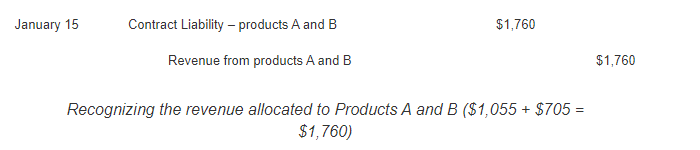
On January 1, 2020, Vendor Y enters into a contract with Customer U to provide Product A, Product B, and a gift card for future purchases in exchange for $1,900 from Customer U. Products A and B have standalone selling prices of $1,200 and $800, respectively, and the gift card can be exchanged for $200 of Vendor Y products. Vendor Y determines from its experience with similar gift cards that, on average, 20% of the balance on any gift card will go unused. On January 15, Products A and B are delivered, but no transactions have occurred related to the gift card. On March 15, Customer U utilizes $100 of the balance on the gift card.
Analysis: Assume that the standalone selling price of the gift card is $160, which Vendor Y expects to be the amount required for redemption.
Product | Standalone Selling Price | % of Total Selling Price | Allocation of Transaction Price |
Product A | $1,200 | $1,200/$2,160=56% | $1,900*56%=$1,055 |
Product B | $800 | $800/$2,160=37% | $1,900*37%=$705 |
Gift Card | $160 | $160/$2,160=7% | $1,900*7%=$140 |
Totals | $2,160 | 100% | $1,900 |
Of the $140 of revenue allocated to the gift card, $28 (20% * $140 = $28) will be recognized as breakage revenue as the customer redeems the gift card. The remaining $112 will be recognized as gift card revenue in proportion to the actual amounts the entity redeems.
Journal Entries on January 15:
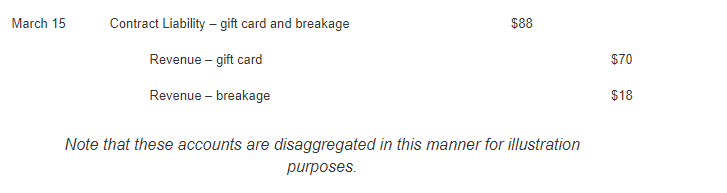
When Customer U redeems $100 of the gift card, they are redeeming 62.5 percent ($100/$160) of the expected total that the customer will actually redeem, so they will recognize that percentage of both the revenue attributed to the gift card (62.5% * $112 = $70) and the revenue attributed to the breakage amounts (62.5% * $28 = $18). The following journal entries will be made on March 15, when Customer U redeems $100 of the gift card:
Journal Entries on March 15:
If an entity can expect to be entitled to a breakage amount, it should reduce the standalone selling price for the estimated breakage, then recognize breakage revenue in proportion to the actual performance it provides. If the entity can’t expect to be entitled to a breakage amount, it should only recognize revenue for breakage once the possibility that the customer will exercise its rights is remote. When an entity provides multiple performance obligations, and breakage is expected for one or more of the obligations, entities should reduce the standalone selling price for estimated breakage before allocating revenue.
This article has been reviewed as of April 2026, and the guidance discussed remains substantively unchanged. Recent pending updates to ASC 606 clarify that the constraint on variable consideration does not apply to share-based consideration payable to a customer that is measured and classified under Topic 718. See Consideration Payable to a Customer and Noncash Consideration for more information. This represents a scope exception for certain equity-based arrangements and does not affect the accounting for breakage (unexercised rights) discussed in this article. Accordingly, the analysis and conclusions presented remain accurate and up to date.