

Published:
Oct 24, 2019
Updated:
Oct 10, 2026

Understand the key differences between variable consideration and customer options for additional goods or services under ASC 606.

Distinguishing between variable consideration and optional purchases can be challenging. Due to significant variations in accounting and disclosure requirements for these two elements, entities should carefully evaluate contracts that may involve variable consideration or optional purchases to determine the most appropriate accounting treatment.
When a contract contains an unknown quantity of outputs, this uncertainty may be accounted for as either variable consideration or optional purchases, depending on the nature of the contract. Entities initially disagreed about whether a contract with an unknown quantity of outputs could qualify as variable consideration; however, members of the Transition Resource Group (TRG) later clarified that, if a promise exists to perform an unknown quantity of tasks, and consideration depends on the quantity of tasks completed, the transaction price is variable. The TRG justified this conclusion by stating that such consideration is contingent on the occurrence or nonoccurrence of events outside the entity’s control, which agrees with the definition of variable consideration in Accounting Standards Codification (ASC) 606-10-32-6.
To eliminate confusion about the difference between variable consideration and optional purchases, the TRG addressed this issue in TRG Memo 48. The memo explains that “the determination of whether a contract contains variable consideration or an optional purchase is highly dependent upon the evaluation of the nature of the promise in the contract.” The TRG provided characteristics of variable consideration and optional purchases to help entities evaluate the nature of the promise in a contract. The following table, which displays these general characteristics, can assist in identifying whether a contract contains variable consideration or an optional purchase:
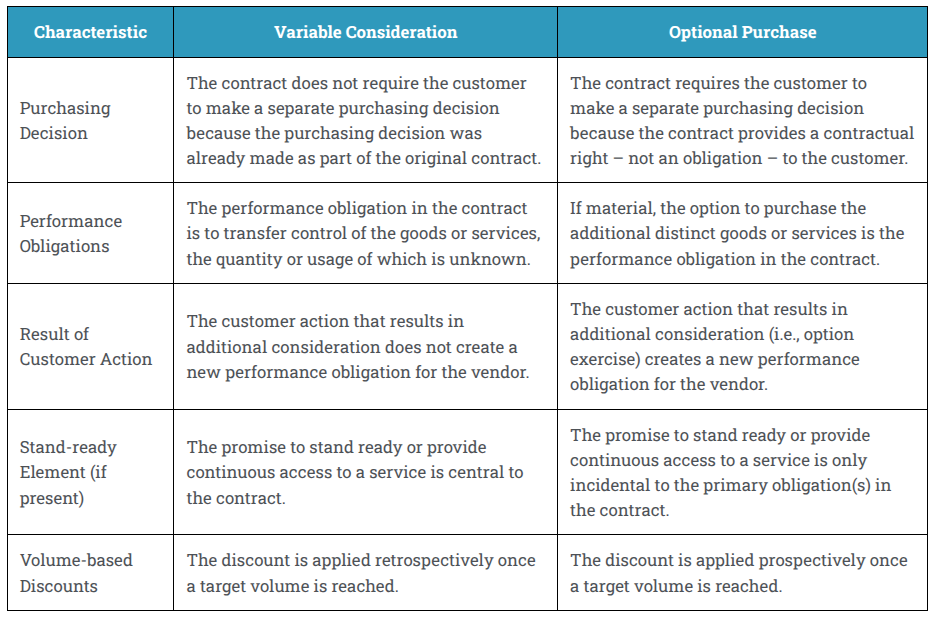
Example 1 - Variable Consideration Biotech enters into a contract to transfer control of medical equipment to Hospital permanently. Payment is based only on usage of the equipment at a fixed rate per kilowatt hour. Analysis The usage-based fee is variable consideration because the only performance obligation in the contract—to transfer control of the equipment—has already been satisfied prior to receipt of consideration. In addition, usage of the equipment does not create a new performance obligation for Biotech, nor does it require a separate purchasing decision by Hospital. |
Example 2 - Optional Purchases Biotech enters into a Master Service Agreement (MSA) with Hospital to supply custom diagnostic testing kits for two years. The MSA requires an upfront fee, and kits are supplied at a discounted rate. Although Hospital is not obligated to purchase from Biotech, it is highly likely to do so because no other supplier exists. Analysis In this example, the upfront fee is essentially a prepayment for the discounted diagnostic testing kits, and Biotech must evaluate whether the upfront fee represents a material right. Furthermore, the purchase of each additional kit is an optional purchase because Biotech is not obligated to supply any kits to Hospital until Hospital submits a purchase order. Once Hospital submits a purchase order, Biotech has a new performance obligation to deliver additional distinct goods. In addition, although the MSA certainly contains a stand-ready element, the nature of Biotech’s promise is to deliver kits to Hospital rather than to provide continuous access to certain goods or services. Notice that a stand-ready service often indicates a single performance obligation that is satisfied over time—which precludes the possibility of an optional purchase because no additional distinct good or service is transferred. However, the TRG has stated that this assumption is not always true. For instance, Example 2 contains a stand-ready element, since Hospital is likely to purchase kits from Biotech, but the stand-ready element is ancillary to the contract’s promise to provide additional goods should the option be exercised (i.e., if a purchase order is submitted). Thus, judgment is required to determine which is the primary obligation in a contract. |
Although the distinction between variable consideration and optional purchases is often clear, some arrangements that are nearly identical from an economic standpoint may be accounted for differently based on technicalities in the language of the contract. The following example illustrates two versions of an agreement that may lead to different accounting treatments:
Example 3A – Variable Consideration Processor offers one-year contracts for transaction processing services and charges customers based only on the volume of transactions processed each month. Example 3B – Optional Purchases Processor offers transaction-processing services and charges customers a monthly fee that includes services for the first 500 transactions. If the number of processed transactions reaches 500, customers may pay a fixed fee for each additional transaction processed. Analysis In both contracts, the ultimate number of transactions to be processed is unknown. In Example 3A, however, the promise is to process any number of transactions during a one-year period. This stand-ready element is the primary obligation in the contract, and the customer’s choice to submit more transactions for processing does not necessitate a purchasing decision by the customer, nor does it create additional performance obligations for Processor. Therefore, this contract contains variable consideration. Conversely, in Example 3B, Processor promises to provide services for only the first 500 transactions, and the customer has the option to purchase additional services. If the customer requests additional processing services, each transaction process represents both a separate purchasing decision by the customer and an additional distinct performance obligation for Processor. Although Processor may expect and even prepare for any given customer to exceed 500 transactions, this implicit promise is incidental to the primary promise in the contract. Therefore, this contract contains an option to purchase additional services. |
When consideration is variable, the transaction price is unknown and must be estimated using one of two methods—the most likely amount or the expected value approach. This estimated transaction price is then allocated to one or more of the performance obligations in the contract, and revenue is recognized as these obligations are satisfied. For more information, refer to Variable Consideration and the Constraint and Allocating Variable Consideration.
An option to purchase additional goods or services is only a performance obligation if it gives the customer material rights that would not otherwise be available without entering into a contract. The right is material if it gives the customer a discount that is incremental to other discounts available to the customer. If the right is material, the transaction price must be allocated to the option based on its standalone selling price (SSP) or an estimate of the SSP if it is unobservable. If an option is exercised, the exercise is accounted for as either an adjustment to the transaction price or a contract modification. Revenue is then recognized when control of the additional goods or services transfers. If the option expires, revenue is immediately recognized. For more information, see Customer Options for Additional Goods or Services.
The TRG admits that, in some cases, the distinction between variable consideration and an optional purchase makes little difference in the timing and measurement of revenue. In Example 3A, for instance, revenue would likely be recognized as each transaction is processed, even if each transaction was considered an optional purchase. Nevertheless, the disclosure requirements may still vary significantly.
When a contract contains an unknown quantity of outputs, determining whether the uncertainty arises from variable consideration or from optional purchases can be challenging. This determination requires judgment as to the nature of an entity’s promise. Although contracts with variable consideration can appear very similar to contracts with optional purchases, the specific characteristics discussed in this article can help entities distinguish between these types of contracts and avoid mistakes in complying with the accounting and disclosure requirements of ASC 606.
Editor's Note:
This article reflects guidance under ASC 606, Revenue from Contracts with Customers, as currently codified, including subsequent amendments. While originally published in October 2019, the concepts discussed remain relevant, as ASC 606 has not undergone substantive changes affecting the topics involved in this article.
EY, Financial Reporting Developments: “Revenue from Contracts with Customers.” September 2019. Section 4.6.
FASB TRG Memo 39: “Application of the Series Provision and Allocation of Variable Consideration.” 13 July 2015.
FASB TRG Memo 48: “Customer options for additional goods and services.” 9 November 2015.
KPMG, Handbook: “Revenue recognition.” December 2025. Section 15.7.20.